
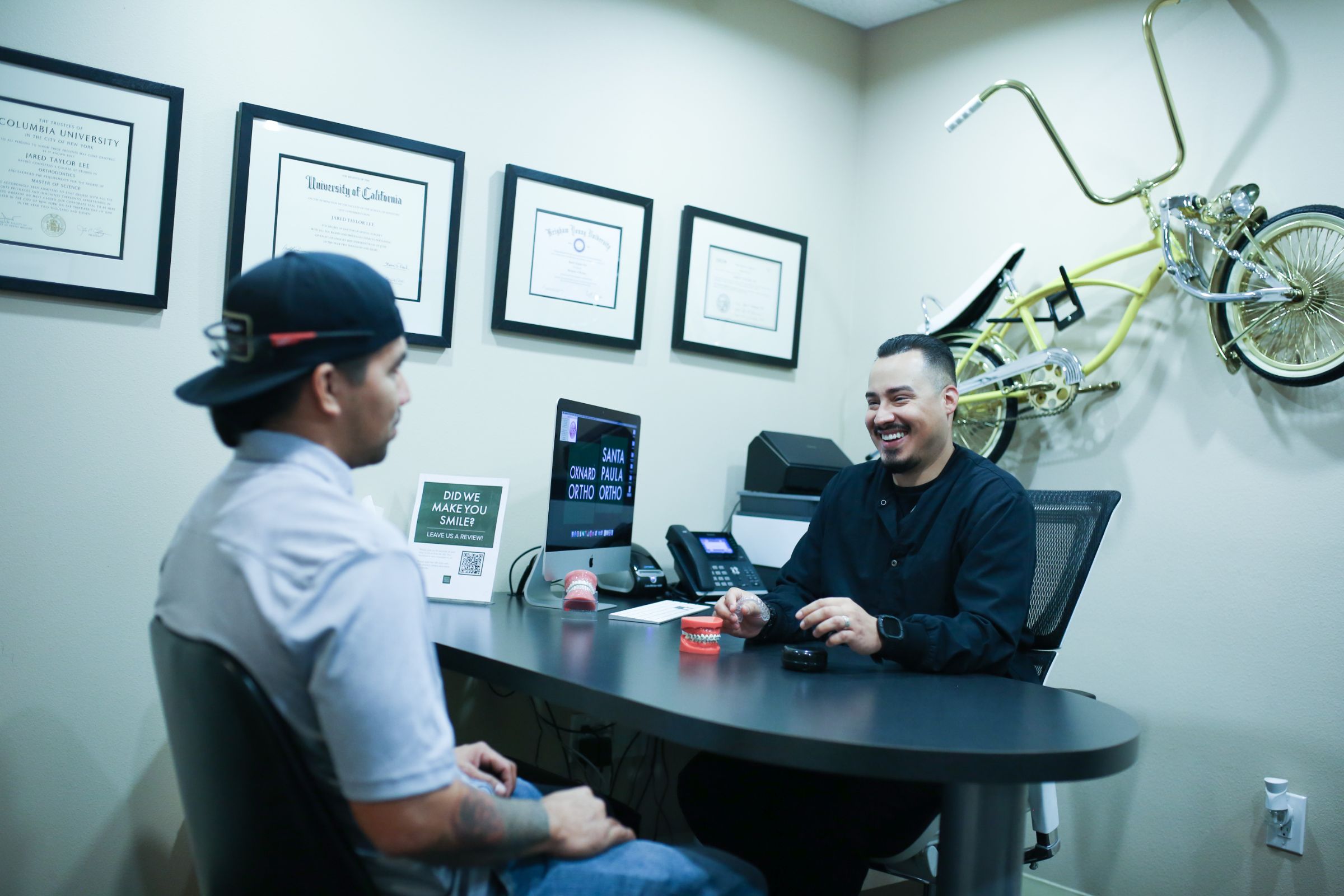
Yes, you can get braces or clear aligners with crowns, bridges or missing teeth in most cases. Modern orthodontics has advanced to the point where existing restorations rarely stand in the way of a straighter smile. With careful planning, Dr. Lee and Dr. Mullen at Ventura County Orthodontics regularly treat adults who have had previous restorations and still want to improve their bite and alignment.
Here’s what matters: natural teeth move through bone when gentle pressure is applied. Crowns, bridges and implants behave differently. A crowned tooth still has a living root, so it can shift. A bridge connects multiple teeth into one fused unit. A dental implant is anchored directly to the jawbone and will not budge.
Many adults considering orthodontics have already had some restorations placed. Maybe you got a crown in your twenties, lost a tooth in your thirties or had a bridge placed years ago. None of that automatically disqualifies you from treatment. Our adult patients come to us with all kinds of dental histories, and we see every background as a starting point, not a roadblock.
At Ventura County Orthodontics, every case gets an individual evaluation. We look at the health of your restorations, the condition of your gums and bone and your personal smile goals before recommending a treatment approach.
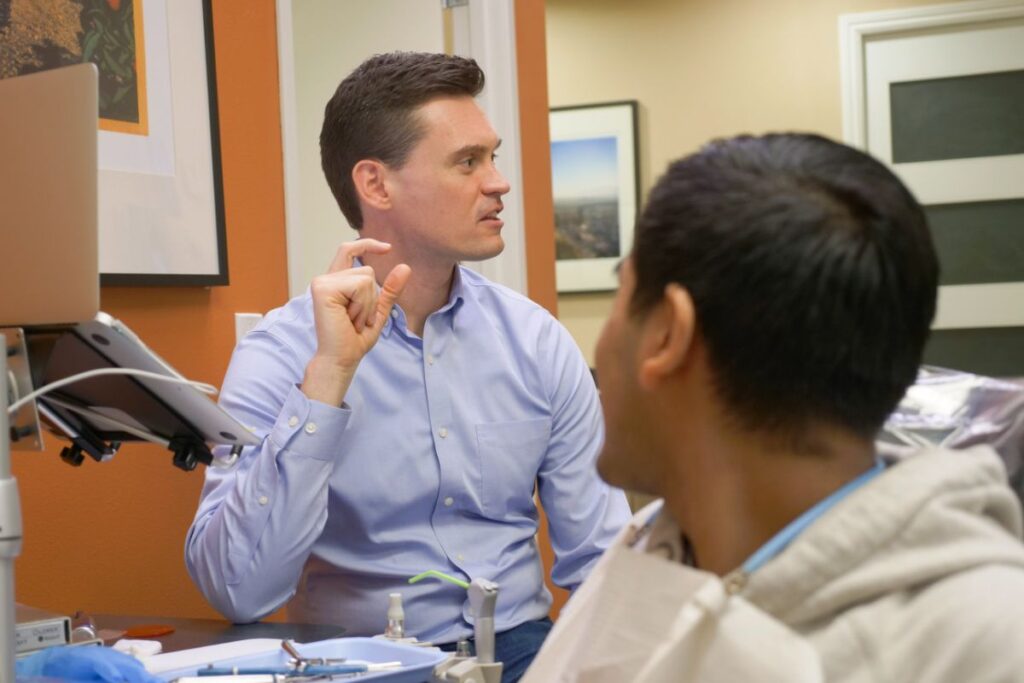
How Crowns, Bridges and Missing Teeth Affect Orthodontic Treatment
Each type of restoration interacts with orthodontic forces in its own way. Understanding these differences helps explain why your treatment plan may look different from someone else’s.
Crowns. Brackets can bond to porcelain crowns, but it takes special adhesives and surface preparation. Standard bonding agents don’t grip porcelain the way they grip natural enamel. Our orthodontic specialists use porcelain primers and conditioning techniques designed for this exact situation. Clear aligners work even more easily with crowns because they grip the overall tooth shape rather than relying on a bonded bracket.
Bridges. A traditional bridge fuses two or more teeth together with a false tooth in the middle. Because the unit is rigid, those teeth move together or not at all. This limits independent tooth movement but doesn’t prevent treatment. In some cases, we plan around the bridge. In others, the bridge may need to be sectioned or temporarily replaced to allow movement.
Dental implants. Implants are fused to your jawbone through a process called osseointegration. They cannot be moved by braces or aligners. Instead, they often serve as useful fixed anchors during treatment, giving us a stable reference point for moving nearby natural teeth.
Missing teeth. Gaps from missing teeth give us options. We can close the space by moving neighboring teeth together, or we can preserve and shape the space for a future implant or bridge. Both approaches require careful measurement and planning.
Before we start, we use digital scans and X-rays to assess the health of each restoration, the bone around it and the position of the roots underneath. This step keeps your existing restorations protected throughout treatment.
Benefits of Straightening Teeth Even With Existing Restorations
Picture a 45-year-old patient who has two crowns from a decade ago, a bridge on the lower right and a slight crowding issue that’s gotten worse over time. Is orthodontics still worth it? For most adults in that situation, the answer is yes. Straight teeth do more than look good. They function better and last longer.
Here are the main benefits:
- Better bite function. When teeth meet evenly, chewing forces distribute properly. Uneven bites concentrate pressure on a few teeth, wearing them down faster and putting strain on jaw joints.
- Easier hygiene. Crowded or overlapping teeth are tough to clean, especially around the edges of crowns and under bridges. Straightening makes brushing and flossing more effective, which protects both your natural teeth and your restorations.
- Preventing shifting and bone loss. When a tooth is missing, nearby teeth tend to drift into the empty space over time. The opposing tooth may also start to over-erupt. Orthodontics can close the gap or hold it open properly, stopping this chain reaction.
- A better foundation for future restorations. If you’re planning to replace an older crown or add an implant down the road, straightening first means the final restoration fits beautifully in a well-aligned arch. That often means a more natural-looking result that lasts longer.
- Discreet options for adults. Clear aligners and clear braces let you improve your smile without obvious metal. For adults with visible porcelain restorations, this is often a big relief.
- Proper spacing for implants and bridges. Teeth sometimes need to be nudged slightly apart or together to create the ideal space for a replacement tooth. Orthodontics sets the stage for restorative care to succeed.
If you already have crowns or bridges in place, the good news is that it’s never too late to straighten your teeth.
Braces vs. Clear Aligners for Crowns, Bridges and Missing Teeth
Both braces and clear aligners can work well when you have existing restorations. The best choice depends on your specific situation, your goals and how complex the planned tooth movements are.
Here’s a quick comparison by restoration type:
| Restoration Type | Metal or Clear Braces | Clear Aligners |
|---|---|---|
| Crowns | Brackets bond with porcelain primers; precise control | Grip the tooth shape; no brackets to bond; gentler on porcelain |
| Bridges | Better for controlled movement of adjacent natural teeth | Works around the fused unit; limited movement of bridge itself |
| Dental Implants | Can treat around implants as fixed points | Often preferred, aligners easily work around implant anchors |
| Missing Teeth | Strong option for closing or shaping gaps | Excellent for maintaining space or gentle gap closure |
When braces often work best: Complex cases with significant rotation, larger gaps to close or bite correction involving teeth next to bridges. The fixed nature of brackets and wires gives our orthodontic specialists precise control over each tooth.
When clear aligners often work best: Adults who want a discreet look, patients with multiple crowns where bonding is less ideal and cases involving implants where aligners naturally work around the fixed anchors. Aligners also come out for meals, which makes cleaning around bridges and crowns easier.
Many adult patients end up as good candidates for both options. Your free consult includes a full discussion of the pros and cons for your specific case, so you can make the choice that fits your lifestyle.
Cost and Timeline Considerations
Treatment with existing restorations sometimes takes a bit longer because we have to plan around fixed structures like bridges and implants. The timeline depends on how many teeth need to move, how far they need to go and whether any coordination with your general or restorative dentist is needed.
A few cost factors to keep in mind:
- Coordinated care. If your plan involves working with a restorative dentist to section a bridge, place an implant or replace a crown, those services are billed separately by that provider.
- Replacing older crowns. Sometimes a crown placed years ago no longer matches the ideal position after treatment. If you choose to replace it for the best final look, that’s a separate restorative cost.
- Insurance. Dental insurance with orthodontic benefits may cover part of adult treatment, though coverage varies widely. Our team files claims on your behalf to make the process simpler.
- Flexible financing. Ventura County Orthodontics offers flexible financing options to help spread out the investment over time.
The clearest way to understand your personal cost and timeline is a free consult. We’ll review your restorations, discuss your goals and give you a realistic estimate based on your actual case, not a generic quote.
Are You a Candidate for Braces With Restorations?
Most adults with crowns, bridges, implants or missing teeth can be treated successfully. The key is making sure the foundation is healthy before adding orthodontic forces.
You’re likely a good candidate if you have:
- Healthy gums. Gum disease must be under control before braces or aligners are placed, since orthodontic treatment with active periodontal disease can accelerate bone loss.
- Stable, well-fitting restorations. Crowns and bridges should be in good condition, without cracks, decay underneath or loose margins.
- Enough healthy bone. Teeth need to travel through bone, so adequate support for the planned movements matters a great deal.
- Realistic goals. Understanding what orthodontics can and can’t achieve with your existing restorations helps set expectations.
- A clear plan for any gaps. If you have missing teeth, we’ll talk through whether to close the space or shape it for future implants or bridges.
Some situations need to be addressed first. Active gum disease, severe bone loss, failing crowns or untreated decay all require attention before starting orthodontics. Our team at Ventura County Orthodontics will tell you honestly if we need to coordinate with your general dentist before beginning treatment.
Your evaluation includes digital imaging, a full assessment of each restoration and a conversation about what you want your smile to look like. Our orthodontic specialists bring years of advanced training to these complex adult cases.
Frequently Asked Questions
Can I get braces if I already have a crown on my tooth?
Yes. Brackets can be bonded to crowns using specialized porcelain primers and adhesives designed for ceramic surfaces. The bond isn’t quite as strong as on natural enamel, so we take extra care with technique. Clear aligners are another excellent option because they don’t need a bracket bonded to the crown.
Can a bridge be attached to a crowned tooth during orthodontics?
Crowns commonly serve as the anchor teeth, called abutments, for a bridge. If you have an existing bridge, we work around it as a single unit during treatment. If you’re planning a new bridge after orthodontics, straightening first often improves the final fit and appearance.
Can you get braces on just a few teeth?
Yes, limited or partial orthodontics is an option for many adults. If only a few teeth need adjustment, perhaps to prepare for a crown, close a small gap or correct minor crowding, treatment can be focused on just that area. This usually means a shorter timeline and lower cost.
Will braces damage my crown or bridge?
Damage to crowns or bridges during orthodontic treatment is rare when proper technique is used. The main concerns are the bond strength to porcelain and the possibility of a small mark when brackets are removed. Dr. Lee and Dr. Mullen use adhesives and removal techniques designed to protect your existing restorations.
Should I get braces before or after dental implants?
Usually before. Implants fuse directly to the jawbone and cannot be moved orthodontically. If you straighten first, we can create the ideal space and alignment for the implant to be placed in its perfect final position. If you already have implants, we plan treatment around them as fixed anchors.
Do I need to replace my crown after braces?
Not always. If your crown still fits well and looks good after treatment, there’s no reason to replace it. Replacement is only recommended if the crown no longer matches the new tooth position, if the aesthetics could be improved or if the crown was already aging and due for replacement anyway.
If you have crowns, bridges, implants or missing teeth and have been wondering whether orthodontics is still an option for you, we’d love to help you find out. Ventura County Orthodontics welcomes adult patients at both our Santa Paula office (800 East Main Street, Suite A) and our Oxnard office (951 West 7th Street). Schedule your free consult with Dr. Lee or Dr. Mullen today to learn what’s possible for your smile.